
The Recycling Myth:
Why Our Blue Bins Aren’t Saving the Planet
The Story We Tell Ourselves
Every year, we churn out more than 400 million tons of plastic. It’s such a massive number that it’s hard to wrap your head around—until you really start looking. You see it tangled in the brush by the highway, floating in the creek after a storm, or piled high in those silent, sprawling landfills we try not to think about. About half of that plastic is made for single use. That is, it could have been made for a fleeting moment of convenience. And then it’s tossed aside forever.
For a long while now, we’ve been made to rely on a feel-good story; if we just recycle, everything will be okay. Every day, households spend their precious time sorting out plastic. It’s become a modern ritual. Yogurt cups are rinsed, the delivery boxes are flattened, and bottles are put into the blue bin with a little sigh of relief. It feels good. It feels like our part in keeping the world clean that our kids will inherit is being done.
But to be honest, that ritual is hiding a messy truth. Recycling plastic isn’t the magic fix we want it to be. It cannot be that magic fix. It isn’t a perfect circle where things live forever. It’s a leaky, expensive, and mostly broken system.
Of course, recycling has its place, but it’s more like a bandage on a wound that needs stitches. In many ways, it just buys us a little more time without actually fixing the problem.
The Circle That Isn’t Round
The idea of recycling fires our imagination, and we see a bottle becoming another bottle, over and over again. That works for metals (things like soda cans, etc.) and glass (jars, bottles, etc.). They can melt them down forever without losing quality.
But plastic is different. It’s temperamental.
Each time plastic is recycled, it gets weaker. Think of it as “downcycling.” That sturdy water bottle might come back as a polyester shirt or a park bench. But it can’t keep changing forever. Eventually, the material gives up. It reaches a point where it can’t be used for anything else.
That is why, instead of a circle, plastic moves in a line—a slow walk toward the trash heap.
Those little chasing arrows on the bottom of our containers gave us a sense of hope. It turned out to be a false hope. The promises made by the plastic industry were just a clever and deceitful marketing ploy. The promises had more to do with profiteering rather than the environment.
The Numbers
Industrial-scale production began in the 1950s and has been gathering pace ever since. Till two years ago, the total amount of plastic produced was 8.3 billion tons. Of that, 6.3 billion had turned into plastic waste. Only 9 percent of that waste was recycled, and 12 percent was incinerated. A whopping 79 percent ended up in landfills, in our oceans, or in the environment.
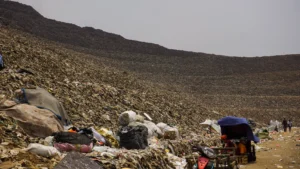
Here are key facts regarding this massive amount of plastic:
- Total Accumulation: Of all plastic produced, nearly 79% has accumulated in landfills or the natural environment.
- Weight Comparison: This total amount is equivalent to 1,400 times the weight of the Great Pyramid of Giza or the weight of 56,000 Nimitz-class aircraft carriers.
- Volume: It is estimated that 9.5 billion tons of plastic (produced to date) would require 18.3 billion cubic meters of landfill space.
- Environmental Impact: Only 9% of this plastic waste has been recycled, while 12% has been incinerated.
- Future Trends: Plastic waste is projected to triple by 2060 if current production trends continue.
This staggering amount of waste is a major driver of global biodiversity loss and poses significant threats to human health and food safety.
That’s a hard pill to swallow. If the system really works the way we hope it does, those numbers wouldn’t be so heartbreaking.
Why It’s So Hard to Get Right
To see why recycling struggles, we have to look at what we are actually recycling!
“Plastic” isn’t just one thing—it’s a huge, complicated family of materials, and they don’t all play well together.
The 7 Plastic Recycling Codes
1 – PETE (Polyethylene Terephthalate): Commonly used for water/soda bottles. Easy to recycle.
2 – HDPE (High-Density Polyethylene): Used for milk jugs, shampoo bottles. Highly recyclable.
3 – PVC (Polyvinyl Chloride): Used in plumbing pipes and blister packs. Tough to recycle.
4 – LDPE (Low-Density Polyethylene): Used for plastic bags, squeeze bottles. Often not accepted in curbside programs.
5 – PP (Polypropylene): Used for yogurt containers, bottle caps. Frequently recyclable, notes Method Recycling.
6 – PS (Polystyrene): Used for disposable cups and styrofoam. Hard to recycle.
7 – Other: A mix of plastics, including polycarbonate and bioplastics, as explained in the Types of Plastic – A Complete Plastic Numbers Guide.
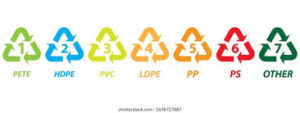
We have all seen those tiny numbers inside the chasing arrows symbol on our takeout plastic containers. The numbers range from 1 to 7. Most local recycling outfits only want #1 (like water bottles) and #2 (like milk jugs). Nos 1 and 2 are easy to deal with and leave enough money to make the effort. But once you get past Nos. 1 & 2 to Nos. 3, 4, 5, 6, and 7, things get murky.
And now the story quickly becomes more complicated.
Materials such as PVC or Styrofoam are seldom recycled. Even the #5 plastic used for yogurt cups is hit-or-miss depending on where you live. The truth is, most of the packaging we encounter every day wasn’t designed to be saved—it was designed to be cheap and convenient for a few minutes, with no plan for what happens next.
This leaves us in a weird spot: we’re encouraged to recycle plastic goods that the system isn’t even built to handle. Our sorting and separating efforts end up fattening the “maybe” pile for stuff that’s likely headed for the dump anyway.
The Money Problem:
Economic Reality
Even if we could fix the tech for the problem of recycling at scale, we’d still run into the wall of dollars and cents. Making virgin (brand-new) plastic from oil and gas is invariably cheaper than cleaning and processing the old stuff. Since the big oil companies already have the infrastructure and the subsidies, they can produce new plastic for pennies.
Recycling, on the other hand, is a complex and costly process. It involves collecting waste from diverse locations, transporting it to facilities, sorting it by type, cleaning contaminants, and then processing it into usable material. Each step requires labor, energy, and specialized equipment.
Compared to producing virgin plastic from oil, recycling is a massive headache. It involves collecting, sorting, washing, and turning it back into something useful. These are labor-intensive operations that require a large labor force, energy, and significant investment. For many recycling centers, it’s a losing battle to compete with the price of “fresh” plastic.
When the minuscule effort at recycling stops making financial sense, cities are forced to make tough calls. Sometimes the carefully sorted stuff gets burned or buried because no one wants to buy it. It’s a harsh reminder that recycling isn’t just an environmental choice—it’s a business. And right now, the business isn’t set up to favor the planet.
What Next!?
None of this means we should give up. Recycling does help—it saves some energy and keeps at least some trash out of the woods. But we need to see it for what it is: a small part of a much bigger puzzle.
The real answer isn’t at the bottom of the bin; it’s at the beginning of the line.
We have to change how we make things. A world built on “use once and toss” can’t be fixed just by sorting our trash better. We need to focus on having less plastic in the first place, designing products that can be used hundreds of times, and holding companies responsible for the mess they create. It also means looking at our own habits—not to feel guilty, but to be more aware of what we’re bringing home.
Right now, we aren’t closing the loop. We’re just stretching it out as far as we can before it eventually breaks.
We are not, as it stands, closing the loop on plastic. We are extending it—stretching it just enough to feel responsible before it eventually snaps.
The path forward isn’t about being perfect recyclers. It’s about a bigger shift in how we value our resources. Until we change the system itself, that blue bin is just a pause in the journey—not the finish line we’ve been promised.
 Author:- Ranjan “Jim” Chadha – a peripatetic mind, forever wandering the digital universe, in search & appreciation of peace, freedom, and happiness. So tune in, and turn on, but don’t drop out just yet!
Compelling